Author: etlerd

Creepy ChroniclesWriting

The Drip

by Lauren Palmer

Its loathsome smell permeates my soul. Every day in the cadaver lab is the same: hours of toil; yet we must master our material. A bucket collects them, but still…the drips are present. Soap and scrubbing does nothing, and the faint stench remains. I’m sure someone somewhere doesn’t mind the smell of formaldehyde. But I am not one of them.

I think I see a flinch. No, I am being irrational. This person is dead. Her arm lies there, motionless. But another drip, it hits the floor. On the steel table, fluids pool as we stand there; plucking at her dead skin, searching for that elusive artery. Or was it a nerve we were supposed to be looking for? We continue on and we scrape away, slowly, at her bony finger. Why can’t we find it? Is there really no more?

Her chipped pink nail polish rests on the tops of her nails. A glaring reminder, perhaps, that she was once as alive as we are now, but is no more. We catch the drips. We wipe the floor. Someone holds her arm out, and her finger drips some more.

Did she flinch? No, this time my partner’s hand accidentally slips and he tears through a vessel. I see the drip in slow motion. It is floating through the air. But it’s not just a drip. It’s that drip. Knowing its origin, I recoil in horror. Did that really just happen? It hit my face, but what’s the real harm? This person is dead, and just a single drop found my skin. I then go home, thinking nothing more.

When I wake up, my eyes are open, but my body is still. My lab partners are looking over me strangely, muttering under their breaths. Why can’t I move? I’m frozen in place. Now here I am, on this cold, steel table. Pizzimenti reminds me, he doesn’t want me to simply “learn” the anatomy, he wants me to “become” the anatomy.

And with that drip…I have.

Creepy ChroniclesWriting

Do organoids dream of dismantled sheep? A spooky sonnet

by J Altman, et al.

“My organoids!” I sob into the night,
Lamenting hours of tireless research.
They hover momentarily in flight
As my intestines plummet with a lurch.

Mere seconds prior, all had been so swell!
All thoughts on my experiment’s design,
I’d known true happiness just for a spell…
That doctorate so nearly had been mine…

But, soft! what stone through yonder window breaks?
And strikes my bench, upending my life’s work?
I know it must be punishment divine!
For why else should I only have mistakes
To show for three long years?! Then, with a jerk,
I waken. “Whew! My organoids are fine!”

Creepy ChroniclesWriting

Practically Confused

by Kruthika Sharma

There was just 6 seconds left on the timer. The structure seemed to elude me. A bit too literally. It was 8 in the morning, we had just started the anatomy practical under these heinous white lights that I could almost hear buzzing, and this muscle was inching down the forearm, bug-like, and grotesque. I blinked a couple times more, and the buzzer rang.

“I must be hallucinating…ugh, I do not have time for this.”

I scribbled down an answer and moved on. As I shuffled to a rest stop, I snuck a glance to my side. No strange movements, the person behind me had already written her answer down actually and was tapping her foot slightly.

We made eye contact, and she smiled.

There on the cadaver, that muscle was moving again, gesturing perhaps? It leapt down near my feet, on the roof of the Capital building on the mouse pad.

I couldn’t scream. This wasn’t worth failing anatomy, I raised my hand while inching away, and the buzzer rang again, surprising me, straightening my back as I walked cautiously to the next table.
Suddenly, a proctor appeared before me on the other side of the table.

“There’s a walking muscle,” I blurted out.

“There are multiple muscles for walking,” Dr. Pizzimenti replied, and before I could explain myself, the creature launched itself from the floor to his abdomen; the momentum had him falling over, straight into a nearby cadaver, that, miraculously, reached out a hand to steady him.

The whole room looked in silence, until the buzzer rang and we moved to the next station.

Creepy ChroniclesWriting

Demonic Anki

by Demonic Anki

With my anatomy exam less than 12 hours away, my brain was already fried, and my Anki had become sentient.

I had 800 cards due, so I began frantically pressing my spacebar.

Origin of the left recurrent laryngeal nerve? Vagus n. Easy.

Another muscle origin. Another branch of the brachial plexus. Another night of frozen Costco chicken strips for dinner. And another anatomy slide I had confidently forgotten three times that evening.

At 3:00 a.m.

Anki: What happens if you damage the long thoracic n.?

I don’t know. I pressed 2.

My shoulder blades suddenly protruded outwards.

Anki: Damage to the serratus anterior m. or LTN causes winged scapula. Remember this association.

I tried closing the app.

Anki: There are still 799 cards to review.

I tried turning off my laptop.

Anki: Override. Avoidance is not an effective strategy.

My ex would’ve agreed with you.

Good one, Anki. I pressed 3.

The next card displayed my student loan balance.

I preferred the winged scapula.

My webcam light flickered green. Something cold rested a hand on my neck.

Anki: Please identify the structure superior to your sternocleidomastoid m.

I pretended I didn’t see it. If it’s not innervated by the long thoracic nerve, I don’t want to look at it.

I suspended the card. The cold hand disappeared. This is technically unit III material, low yield.

Creepy ChroniclesWriting

Tiny Twist of Terror

by Lydia Bembnister

It was dry, brittle, yet somehow… pliable? Like the dried needles of a Christmas tree. And then it hit my nose. Not warm and piney, but rather sweet, foul… That smell broke through my shock, as I stood there staring at the patient’s dessicated finger in my palm. Then the last agonal gasp fluttered through their lips, and their eyes, wide open and fixed in death, watched me as I set the finger back with the hand I had tried to hold, and went to tell the charge nurse we now had an open bed for the new admission.

Creepy ChroniclesWriting

Blue Zombie Uprising

by …🧟‍♂️

Operation Title: Overwhelming Outrage

Status: Containment breached

Summary of Events: On 10/21/2027, farmer Lach Zahn (no relation to prominent medical student Cole Zahn) contracted a novel parasite when he accidently switched his radio to IPR while driving a combine in Johnson County. The initial attack on his nervous system caused him to crash the combine and prompted a response from EMS. Upon arrival, the first responders noted the radio was still on and within minutes were also overcome by the parasite. CNS function returned to baseline within the hour and those who later came into contact with them noticed subtle personality shifts and about half were stricken by similar nervous attacks. The parasite has spread rapidly throughout the state of Iowa and into bordering states. Prominent symptoms include a strong urge to vote in elections and a preference for the color blue. The latter symptom has led media commentators to quickly label this a “Blue Zombie Uprising.” Brain parasite expert, Robert F. Kennedy Jr., has analyzed the novel parasite and reports that it can only cross the blood brain barrier while the host is receiving information that is highly contradictory to their personal beliefs which triggers an elevation in cerebral blood flow to aid in neural processing. His recommendation for protective ear plugs has gone largely ignored. The ICE agents who have been mobilized in an attempt to contain the outbreak have proven to be particularly affected by the parasite and have only added to the number of infected individuals. President Trump has reportedly attempted to initiate a nuclear response against the population centers that have been lost to the parasite in order to contain the outbreak, but previous staffing cuts carried out by DOGE have removed personnel with key operational knowledge and left the system unusable. America has fallen.

Illustration

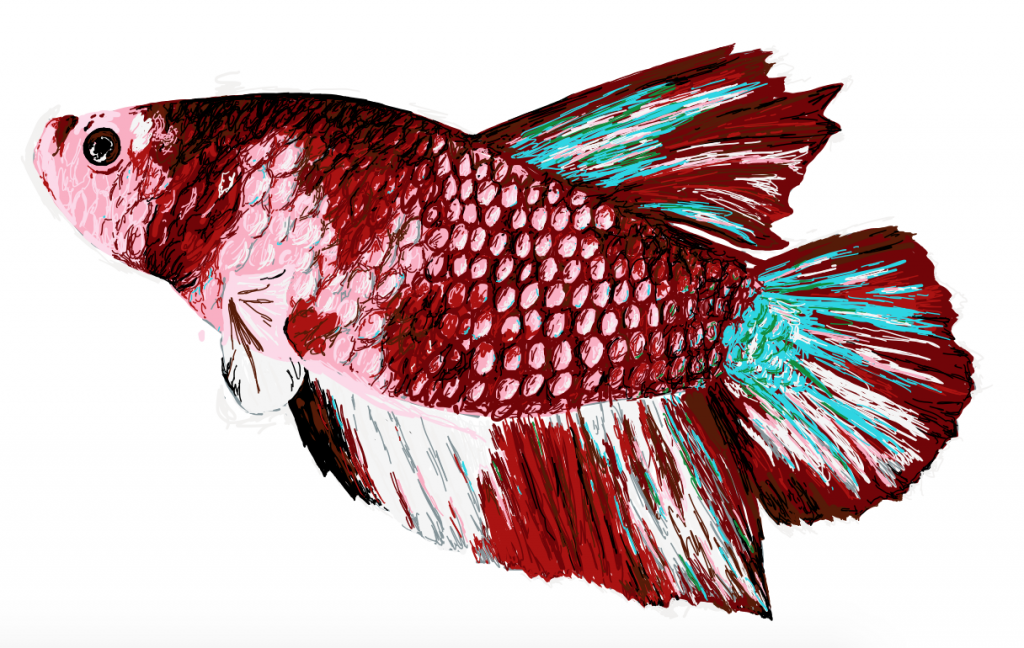
Beta Fish

About the Author

Kristina Sevcik MD is a former medical student at the Carver College of Medicine. She is currently a first-year pathology residency at the University of Nebraska Medical Center.

PoetryWriting

Pruning

It’s okay to rip flowers out
and to set fire to vines,
to pluck petals off without
counting to love me
or love me not.

It’s okay to let fruit spoil
without giving it a chance
to taste sweet.

It’s okay to have weeds and bees
and birdbaths full of June bugs,
to plant watermelon seeds
that will never grow.

It’s okay to cut the heads off roses
and to water the bush that will never bloom.
It’s okay to dance
in a garden of goodbyes
to let go,

to make room.

About the Author:

Hannah Erlbacher is a medical student at the Carver College of Medicine. Her favorite medium is poetry.

Writing

Schrödinger’s PET

This is a ritual. 

I know that because this practice now transcends the routine and embodies life itself for me. I began this pilgrimage in a different life, but its continuation in this one sustains me. I approach these days with the sacredness of a priest, but I see no salvation in them like a non-believer. 

Slowly, my eyes refocus on the surrounding room. It is dark in here, except, a faint luminosity trickles in from the nearby room that is separated from me by a pane of glass. The only other room that I know of which resembles this one has one way glass, and the police use it to interrogate suspects. 

In a way, I guess that is why I am here too.

 I begin to slide into a familiar cylindrical opening.  I can see the words, “Do not stare directly into the laser aperture.” 

I always think that aperture is too big of a word to use for such a small space. 

But, I do not design these machines, in fact, I never want to see one ever again. Let them use a five-dollar word where a one-dollar word would do. It does not matter. Nothing really exists in here anyways. Suddenly, a light whirring noise cracks the façade of tranquility, and a rhythmic electronic beeping noise interjects itself between my thoughts. I settle into the paper lining beneath me, and I lie still, stiller than I have ever been, but not as still as I will ever be. Sometimes, I think that if I am quiet enough, I will be able to hear the radioactive tracer coursing through my veins, riding the superhighway of my blood vessels to the farthest reaches of my being. I know where the road ends. The tracer always coagulates into an unmistakable pattern before the radiologist’s eyes. It always shows cancer. 

I used to arrive here brimming with the anxiety that inexactitude and uncertainty create, but not anymore. I have begun to enjoy, even relish, this ritual in my interrupted life. The more time that I spend in here, this coffin, this ark, the more I realize that this is the only place that I do not have cancer. I had cancer when I began to slide into this machine, and I may when I get out, but right now, until they see the scan, this precarious existence that I have temporarily carved out is a paradise of unpredictability. For the fifteen or twenty minutes that I am in here, I exist outside of five-year survival rates. I tower above the looks of pity that I receive soon after their eyes meet my smooth skull. I am not cured either, no, but while the machine works, I am at peace. 

Afterwards, I sit waiting in an exam room while the radiologist maps out my existence. Absently, a half-paid attention to high school physics lesson floats into my mind. That day, my teacher told us to visualize a cat in a box. We were asked to imagine that there was a poisonous chemical in the box with the cat that had a fifty percent chance of killing it. The catch was, until someone opened the box, we could not know if the cat was alive or dead. Until that time, it was both. The lesson was designed to teach us something about quantum theory, but I never quite understood it. How could something be both alive and dead? As I sit in my chair, neither alive, nor dead, I understand perfectly well. 

My doctor enters the room and stands before me holding the results of my scan in his hand like an ancient Roman emperor whose thumb hovers parallel to the ground before he decides if the gladiator should live or die. 

He looks at the paper, pauses, and then looks up at me. 

If formerly society was founded on a renunciation of enjoyment for the sake of social duty, then the only duty today consists in becoming oneself (to appropriate Todd McGowan). This piece posits that mental health discourse today only offers a new injunction for its subjects: to become self-identical, to self-actualize. We are increasingly told to “normalize talking about mental health”, but isn’t this declaration already anachronistic? Our mental health seems to be all that we can talk about, a new mode of narcissism only thinly veiled as somehow political, progressive, subversive. But if we have already absorbed the platitudes of liberal mental health discourse, then why is the mental health crisis worsening? The piece contends that it is in fact the presuppositions of mental health discourse that are the environment in which mental health issues form, that it is out of a dissatisfaction with an individual failure to achieve the imperatives foisted upon us by mental health discourse that mental health symptoms emerge. The solution is in fact the problem, and it is only when we challenge the notion of the individual undergirding mental health discourse that we can contend with the current mental health crisis, by positing an alternate model of the subject as relational, rather than as substantial entity, in which such a project of self-actualization becomes meaningless, and find meaning elsewhere (through collective emancipation).

About the Author

Will Moody graduated from the University of Denver in June 2020 with a degree in molecular biology and plans to apply to medical school in June 2021. In May 2020, Will was diagnosed with Hodgkin Lymphoma and after undergoing treatment was informed his cancer had returned in November 2020. Writing has been a much needed creative outlet for him during this time. Will is currently working on his first book and spending time with his family while he continues treatment. His writing also appears in Pulse – Voices from the Hearts of Medicine, Aspiring Docs Diaries, and his blog, The Rest of Your Life.

Writing

Hand in Hand

I had just set up my post at the volunteer desk and was midway through the process of screening a visitor, asking, “Have you had any recent fevers, cough, …” when one of the hospice nurses, Nyah,  quietly interrupted me. “Excuse me, would you be willing to go sit with 12?” “She isn’t doing well.” My heart raced, but I responded with an unwavering, “Yes, of course I can!” I walked briskly to the end of the corridor and found the patient’s room. I was greeted with a flashy, yellow sign, indicating a positive C. difficile infection, so I took appropriate precautions prior to entering her room. 

Upon entering, a CNA met my gaze and knowingly passed on what seemed like everything I needed to know, without even saying a word. Her face told me the patient unfortunately did not have long. I pulled up a chair and tried to get to know more of who “12” was. Glimpsing up at her care team board, I saw a familiar scene: in faded dry erase marker, there were multiple family members’ names and their phone numbers scrawled all over. Some left messages, “Get well soon, Grandma!” and “We love you!” others drew little happy faces, stick-figure drawings of themselves, or sketches of dogs and hearts. I gave May’s hand a light squeeze with my gloved hand. The board also listed May’s recent medications, her husband’s name, and Lutheran, as her religious affiliation. May struggled to breathe, showing signs of a Cheyne-Stokes breathing pattern, but I asked her if she would like me to pray for her. She attempted to respond, but her labored breathing allowed her only a nod. For a brief second, May was able to hold eye contact, and in her eyes, I could see that she wanted relief. 

Immediately, fear washed over me. What if my prayer wasn’t what May wanted to hear? How do I know what her specific requests are right now? I squeezed her hand again, before praying for peace and comfort for May. My prayer lifted, and again, I gave her hand a light squeeze. This time, May’s eyes were unable to focus on me, and I could tell she was steadily slipping towards death. I wondered deeply who May truly was and wished I had a time machine, bringing me back to the highlights of her years. A septuagenarian, I couldn’t help but think how she was affected by the pandemic in her final year of life. Without knowing May and the intricacies of her life leading up to this precious moment, it was impossible for me to know just how profound of an impact masks, gowns, face shields, and other measures of PPE had on her life. I wanted so desperately to remove my glove and provide skin-to-skin contact in her last moments. Instead, I offered a few more words of comfort and solace to May, and mostly just sat in silence with her, as her breathing drifted and her skin began to pale. Her limbs grew limp. A tear rolled down my cheek, burying itself in my mask. 

Suddenly, the door opened, and in walked May’s husband, Gene, bewildered by May’s lifeless body. His partner of almost 50 years had only just passed, and he was in shock. He abruptly dropped his cane, which clanged off the ground with a stark metallic pitch that reverberated through my bones. Gene’s words faltered as he looked towards me, “I, … Who…?” And then stuttered, “Mmmay?” I didn’t respond, knowing that his thoughts would assemble in time. I excused myself to give Gene space to mourn, and later that evening, I was approached by Gene and May’s daughter. She introduced herself as Sharon, and then she asked me if she could hear about my last moments with her mom. Her puffy, swollen eyes, and long solemn face peered into my soul, as I provided details of the experience, praying, squeezing her hand, and trying to comfort May with my presence. May’s daughter beamed with gratitude and burst into tears, stating that her mother had been isolated for months leading up to her death, due to COVID-19 restrictions at the nursing home she was in. I could tell she wanted nothing more than to be with her mother and to be the one to hold her hand, but she managed to say, through a river of tears, “Thank you for being there for her. And praying with her– that was so kind of you.” When I met Sharon’s eyes to respond, an outpouring of tears fell down our cheeks, almost in unison, knowing that an act of mourning had just brought us closer. 

Grief is a nearly palpable feeling felt deep within, and after May’s death, I carried her loss physically, mentally, and emotionally. The staggering death toll due to the novel coronavirus over the past few years is a constant reminder of grief. With every number that ticks across the television screen, there is likely someone, somewhere, grieving their loss. Shared mourning may assuage fears of some, reconciling to others, and aggravate opinions of a few. The process of remembering individuals who have died, either to direct or indirect factors related to the pandemic can bring healing. The connection May and I had in her final moments revealed that sitting close, hand in hand, did not require a familial relationship, only a bond that unites us all — as human beings. As continue to move toward the resolve of the COVID-19 global pandemic, a cloud of enduring grief hangs low, and we continue to mourn. May we draw upon our shared experiences, recall the power of presence, and surpass traditional boundaries to create new connections with one another. 

The patient’s name and other details have been changed to protect patient privacy.

About the Author

Mikayla Brockmeyer is a second-year osteopathic medical student at Des Moines University. She enjoys narrative medicine, reading for pleasure, and trying new ice cream flavors.