Artist Feature

3D ArtArtist Feature

Artist Feature: Abby Walling

The Appendix interviewed medical student and artist Abby Walling on her process of making stained glass art.
Q: When/how did you get into creating stained glass?
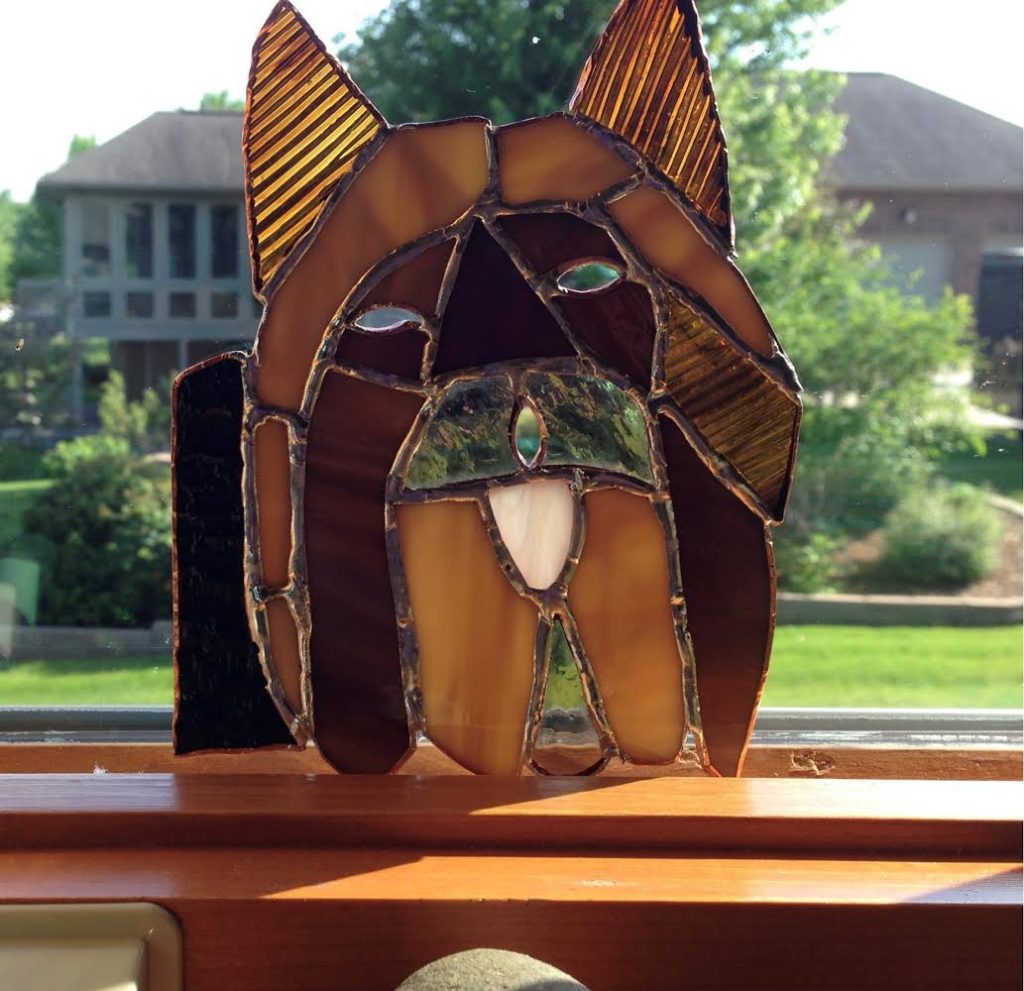
A: I took a stained glass class my freshman year at West High School. It quickly became a long-term hobby once I realized how much family and friends liked receiving stained glass presents.
Q: What does your creation process look like?
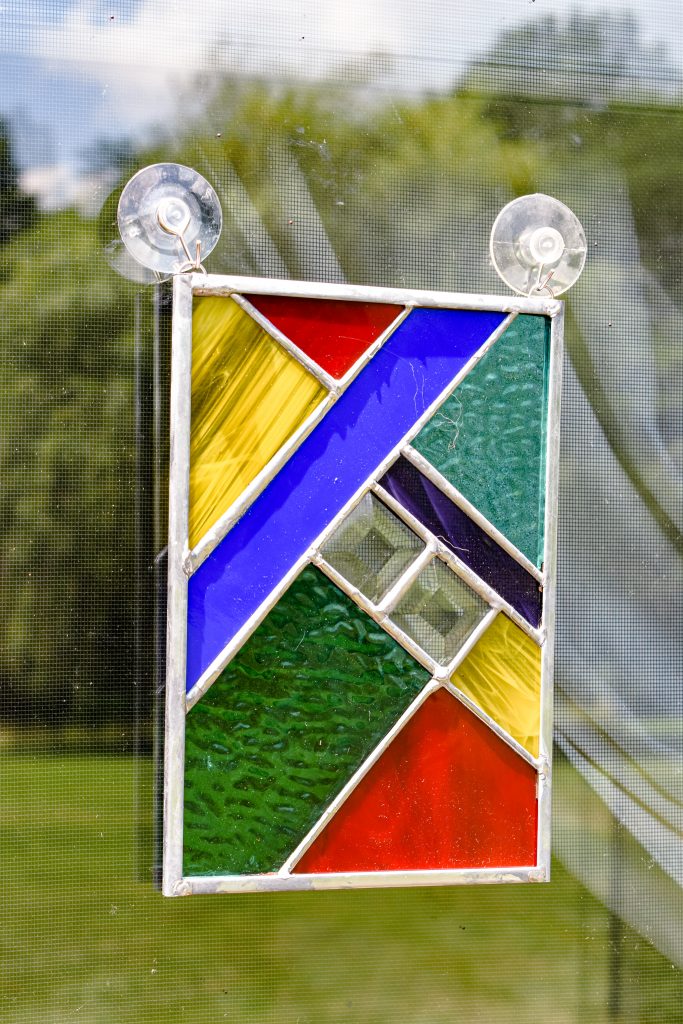
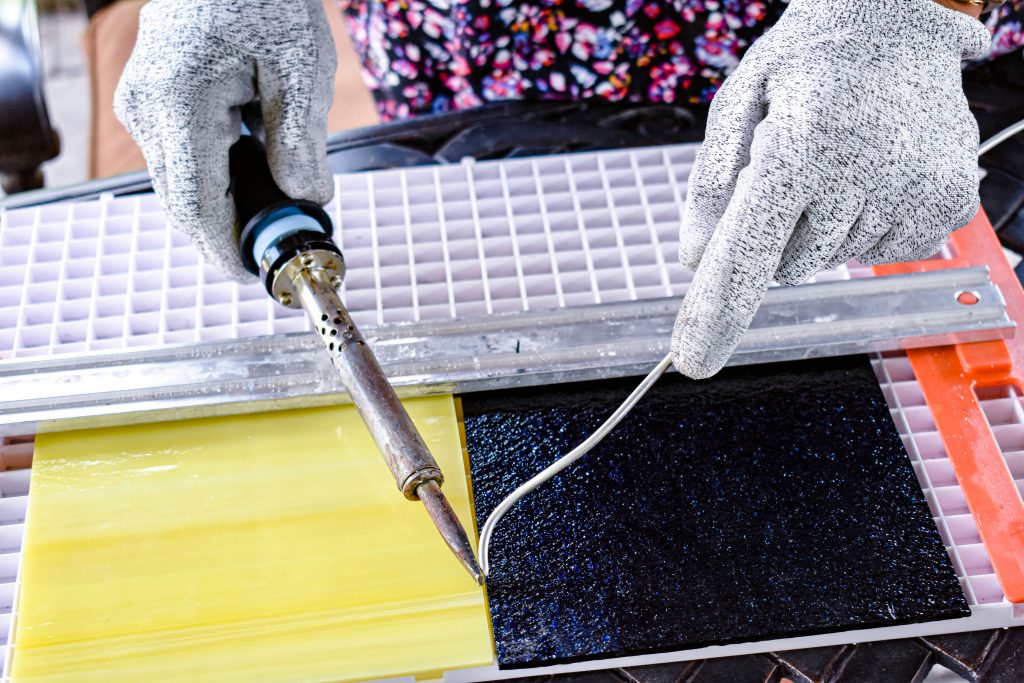
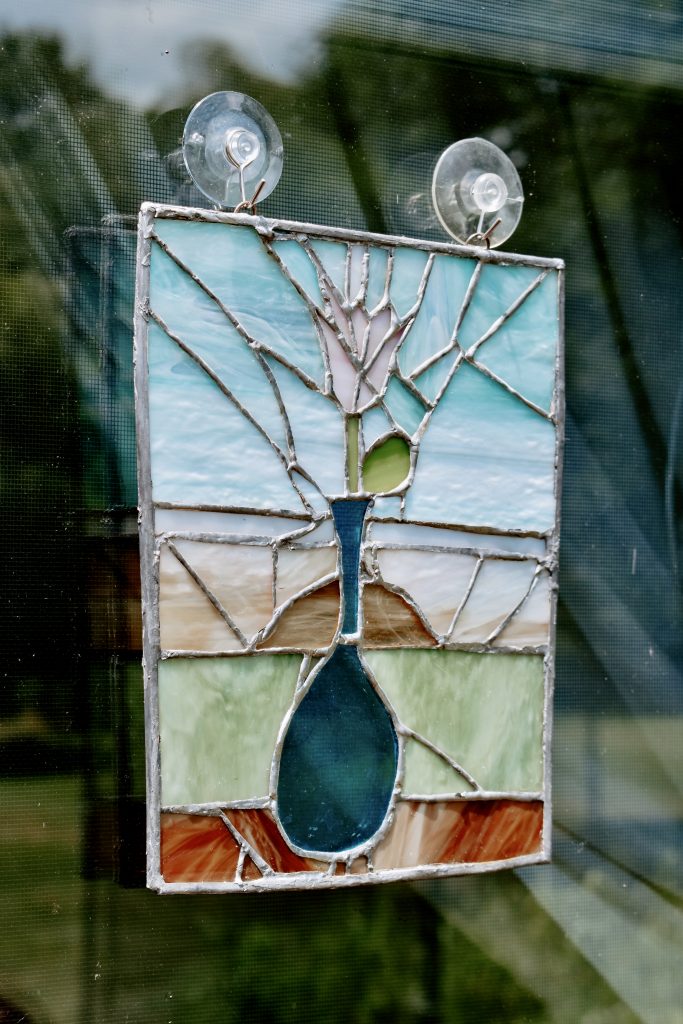
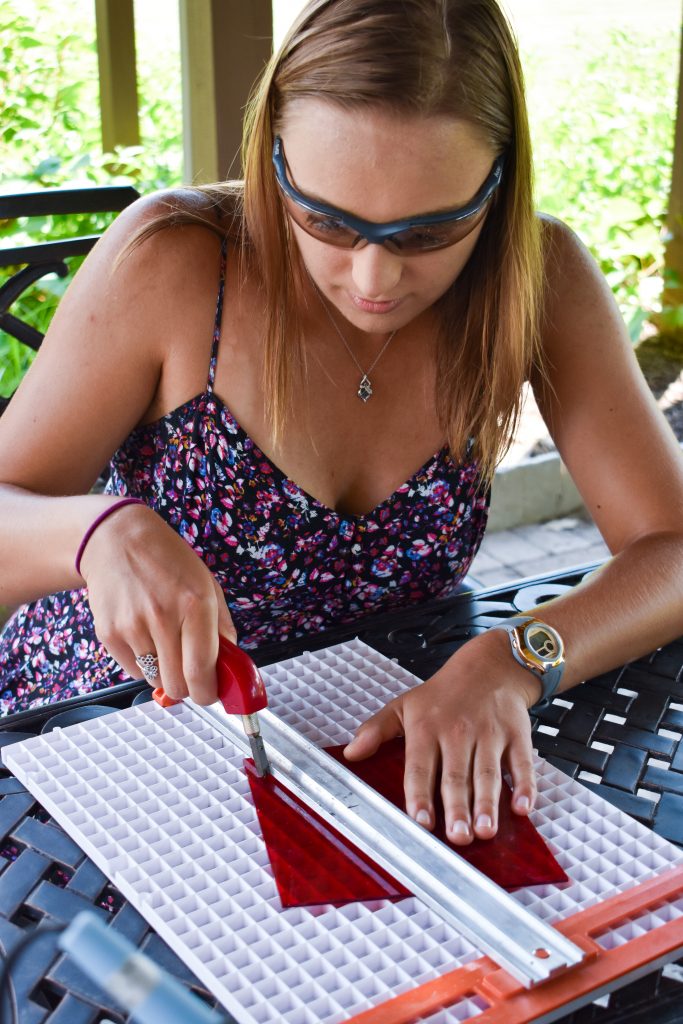
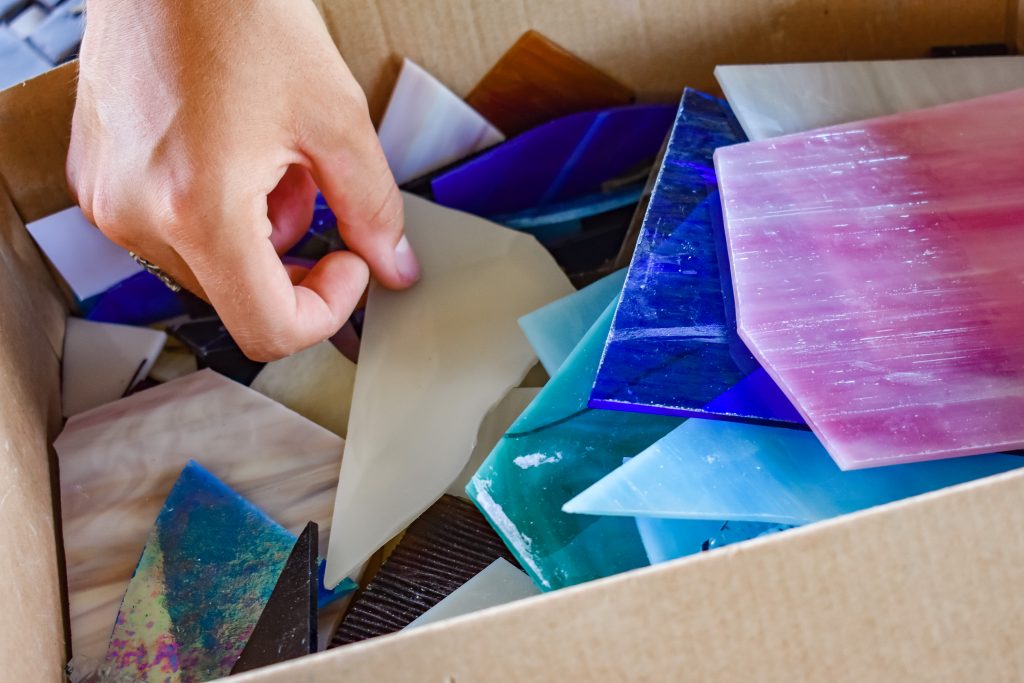
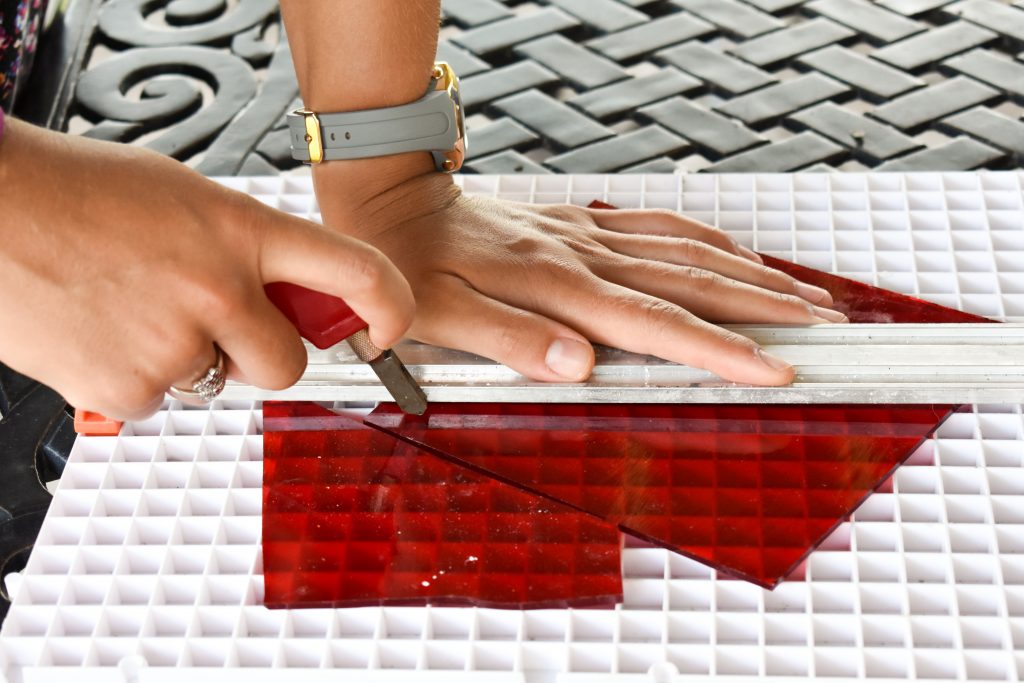
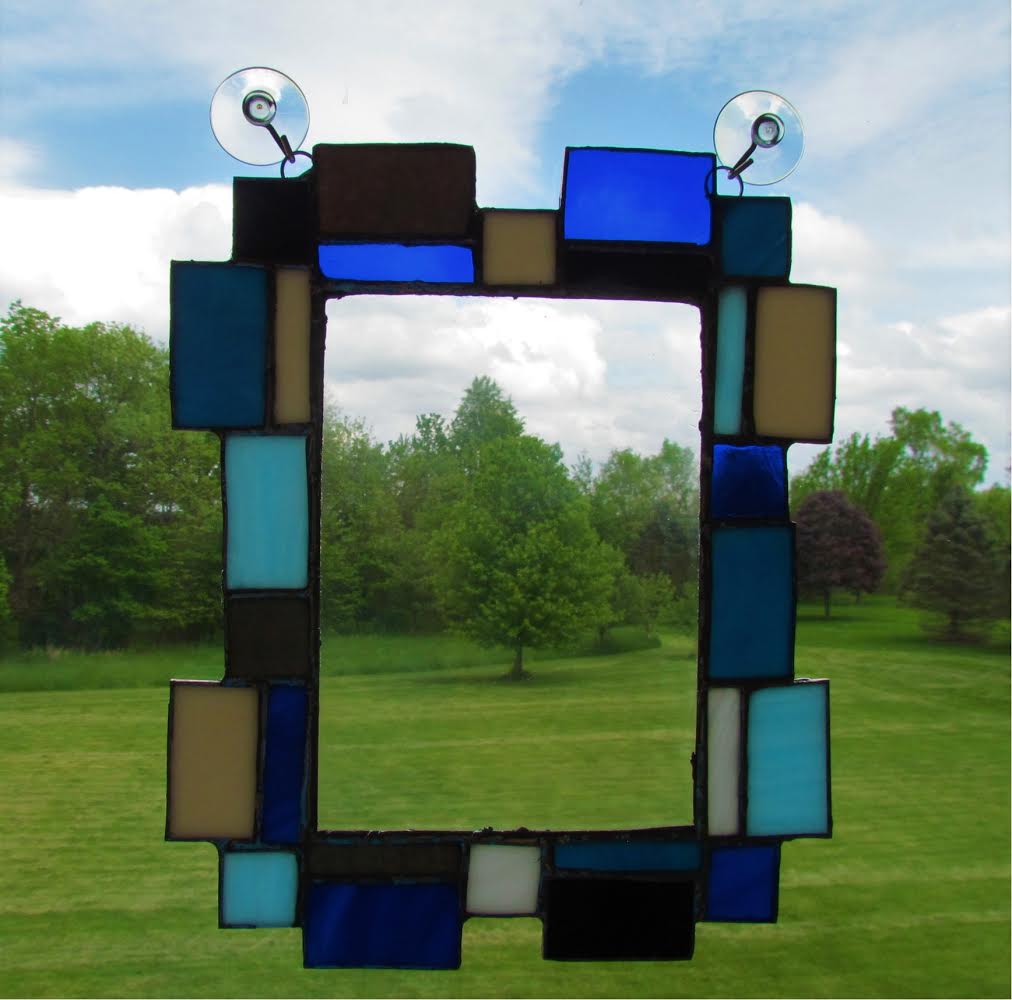
A: I start by receiving a specific request for a piece from a customer (usually family or a friend) who might have a general idea of what they would like. For example, if someone wanted a bird piece, I would make several sketches of birds and have them choose their favorite. I print off the sketch, cut out each piece, and glue it on the associated color of glass. I then run a glass cutter along the glass (like a mini pizza cutter), and use a glass grinder to smooth out the edges. After cleaning each piece, I cover the edges in copper foil. Next, I use a soldering iron to melt solder, which melds the pieces together wherever the copper foil is sticking. Lastly, I frame the completed piece with zinc came (connecting the frame edges with solder) and solder a key ring so the piece can be hung on a window with a suction cup.
Q: How do you think your art reflects in your daily life?
A: Stained glass has helped me become more of a visual learner. I’ve started understanding things I’m studying (like a disease or drug) as a large puzzle or picture with many difference pieces that fit together. Sketchy Medical has really helped me tune into this type of learning!
Q: What are you working on right now?
A: I opened a business on Etsy as soon as quarantine started. It became a full-time commitment; I was creating about two pieces a week, designing the website, and advertising the business. Unfortunately, I deactivated the business once school started again to focus on studying. In the future, I may start planning small pieces for friends’ birthdays that I can make during school breaks.
Q: Who/what is your inspiration?
A: I have always admired the stained glass in churches and cathedrals around the world. It is truly inspiring to think about the years it would take to create a detailed, full-window piece. I have always hoped to take a month off to create a simple custom-sized window once I own a house.
Q: What would you like people to know about your art?
A: I would like people to know how much time and effort I put into every piece I make. The whole process is like drawing a puzzle, then creating each piece, then putting the pieces together.
Q: Can you tell us about any intersections between your art and the health sciences?
A: My love for stained glass was actually the main reason I wanted to become a surgeon. Practicing this precise art for 10 years has helped me work on my skills in attention to detail and patience. I hope to transfer these skills to one of the most detailed procedural subspecialties, ophthalmology, and help improve people’s vision enough to truly appreciate the beauty in the world.

Q: How has creating your art changed you as a person?
A: I definitely have a greater appreciation of art, small businesses, and advertising. I learned a lot from running my own business, especially how stressful and frustrating it would be to depend on that business for my living. I also like to think that I translate the attention to detail from making stained glass into my studies. While learning, I try to focus on each detail of a disease or drug before looking at the concept as a whole. In this way, I’m better able to understand how everything fits together.

About The Creator

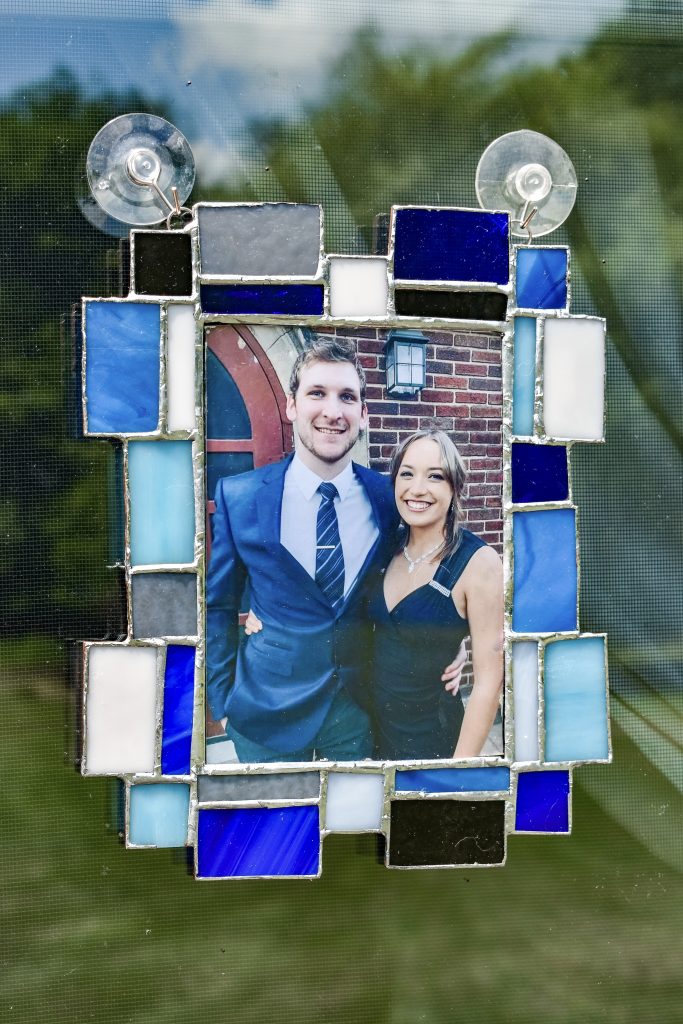
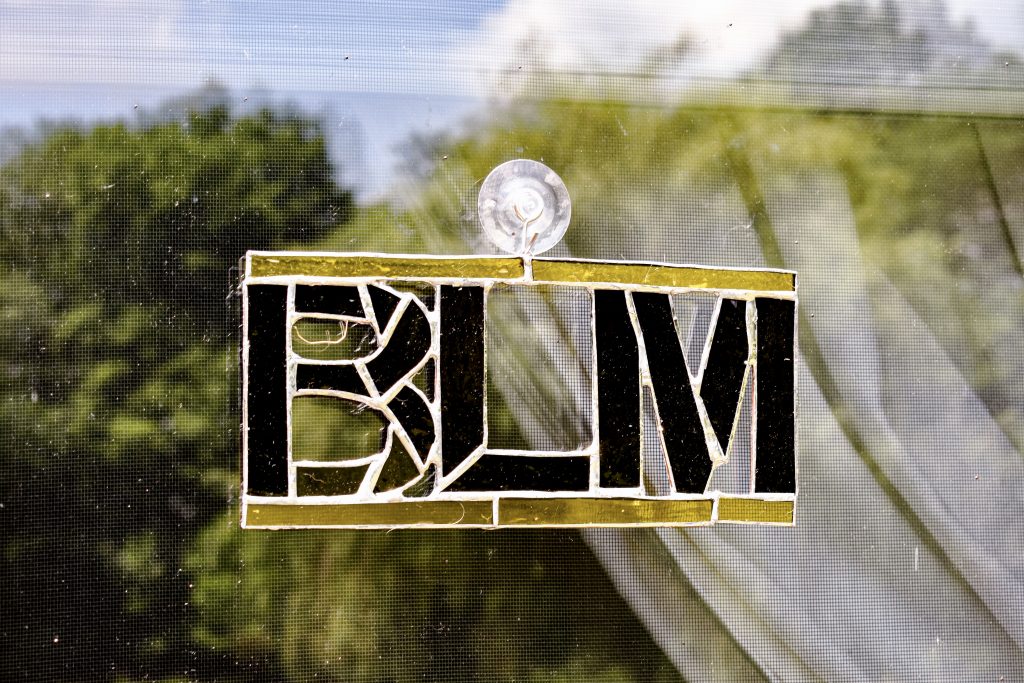
Abby Walling is a second year medical student at the University of Iowa Carver College of Medicine. These are some of her favorite pieces.

Artist FeatureIllustrationPainting

Artist Feature: Zain Mehdi

Zain Mehdi is a first year medical student at the Carver College of Medicine and a talented multimodal artist who works with graphite, oil paints, acrylics, watercolor, and more. The Appendix‘s Anna Graeff had an opportunity to interview him about the intersections between his art and the health sciences and how art is reflected in his daily life,

Q: What type of art do you create or have you created in the past?
I’ve found that my art is influenced by many different sources in my environment, whether it be
from a kids’ picture dictionary, spending time outside, finding inspiration online, or social issues I
have a passion for. I have played around with various media and topics, but I particularly love
acrylic painting and colored pencil artwork that combine realism and abstract art to express a
message.

Q: When/how did you get into creating?
I began drawing and painting in kindergarten and have loved creating ever since.
In sixth grade I was taking online courses to improve my English skills, and that inspired me to
begin creative writing as well.

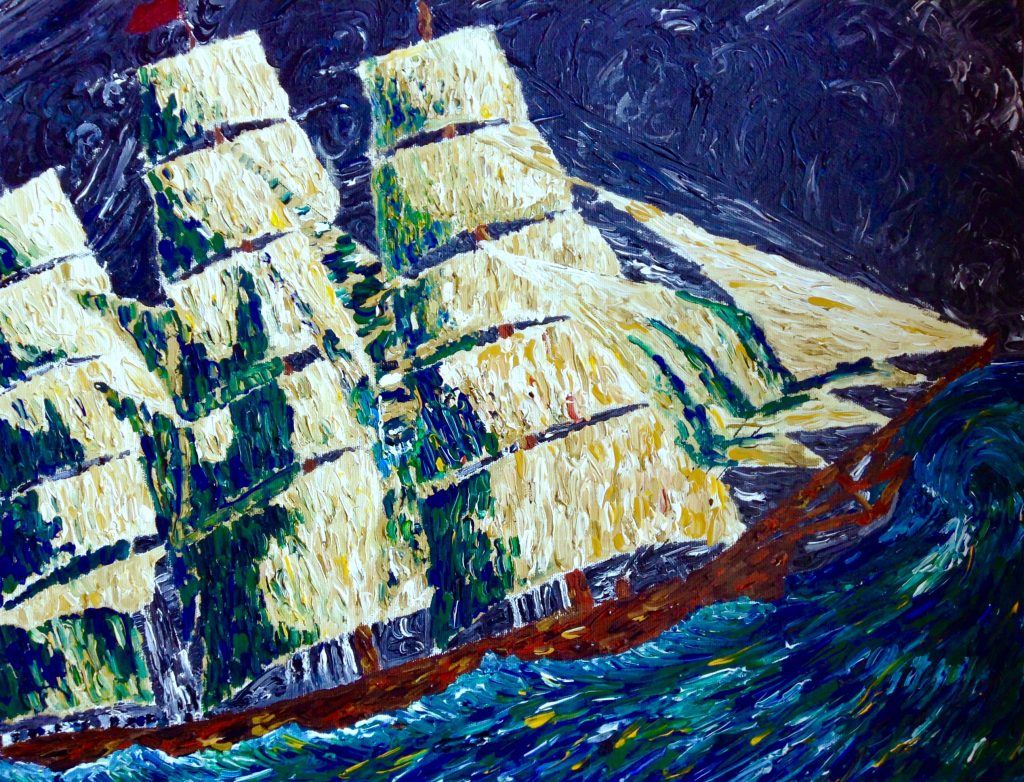
“At Sea,” acrylic paint
This painting depicts a ship at sea in the night with a highly textured painting style, reminiscent of Van Gogh’s painting technique.

Q: What does your creative process look like?
I like to doodle just for fun. On the flip side, when I make a large piece of art, I usually
research my topic of interest, begin sketching, and make edits to my original design before I
reach a final product. Large pieces that I create definitely have a more complex process that
goes into them.

Q: How is your art reflected in your daily life?
As cliché as it may sound, art is an outward expression of how I think and feel internally. My art
enables me to demonstrate what is important to me and allows others to gain greater insight
into my interests and concerns.

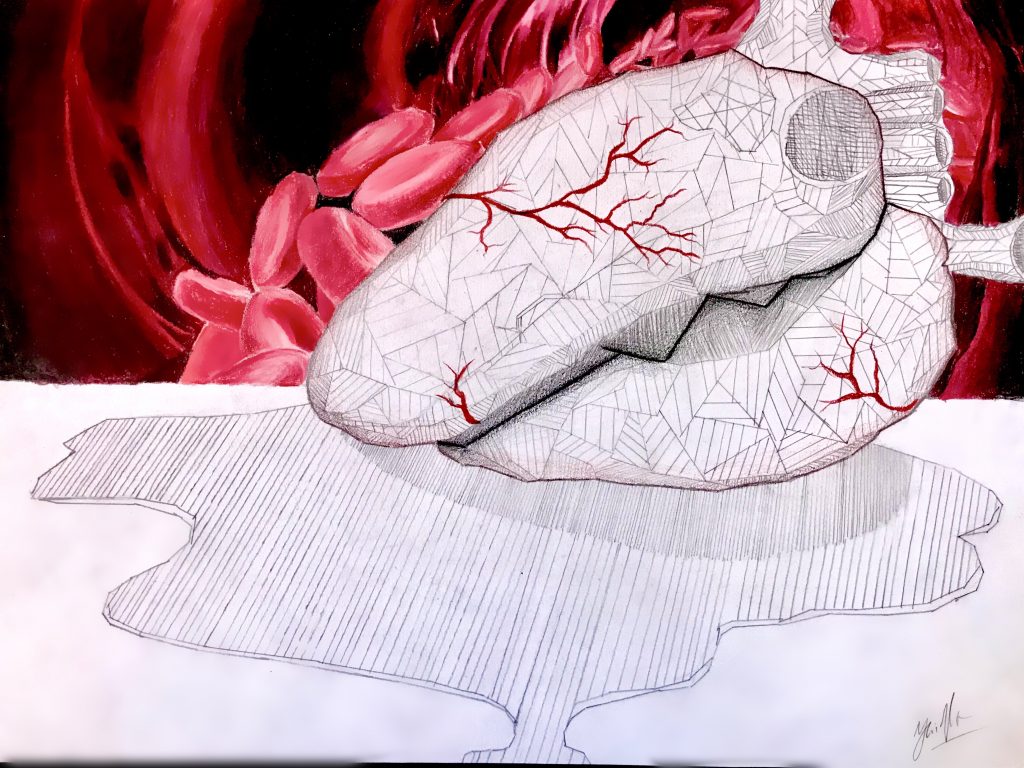
“Leeched of Life,” colored pencil and graphite pencil
This piece depicts a human heart leeched of color and much of its depth, shown in stark contrast with the vibrant blood vessel in the background. Emotional distress and depression can leech the color out of one’s life, not just on the outside but inside as well.

Q: What are you working on right now?
I’ve been meaning to write a novella and have started that process. In terms of art, I am working
on an acrylic painting of the hot air balloon festival in Cappadocia.

Q: Who/what is your inspiration? What art do you like to consume?
I have always liked the use of primary colors in Van Gogh’s paintings. I also enjoy the
composition of Chuck Close’s and Jonathan Darby’s portraiture. In terms of writing, Gerard
Manley Hopkins, W.B. Yeats, and Robert Frost are all poets that I admire.

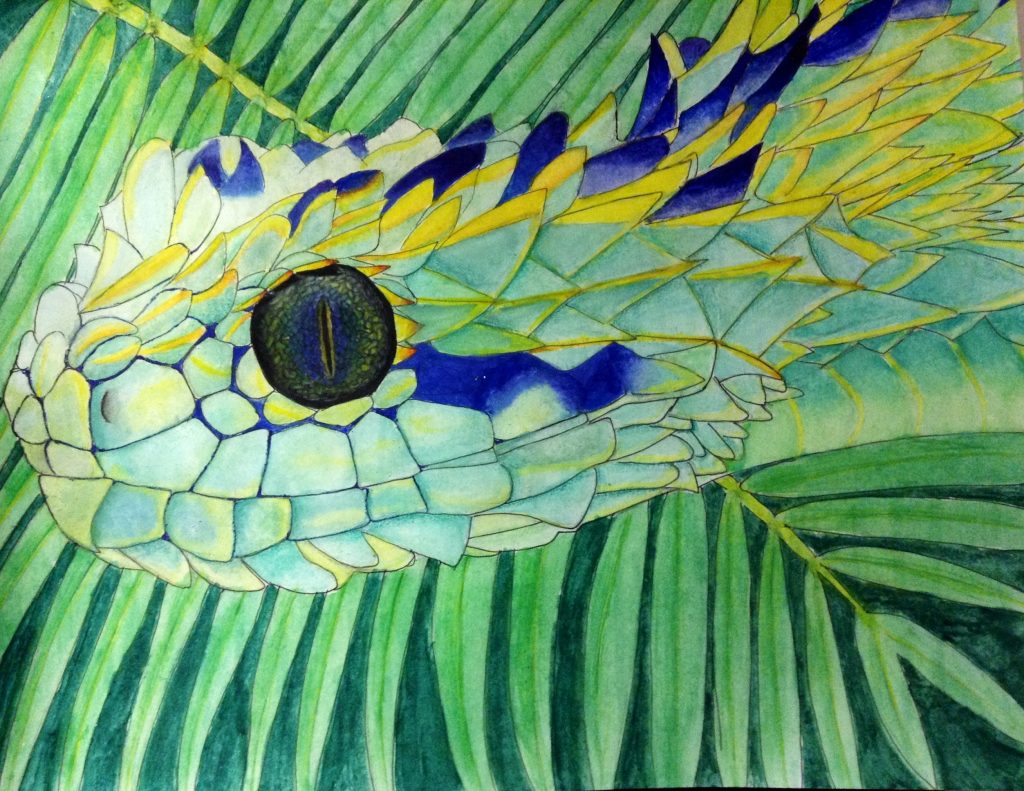
“Snake Eye,” water color and colored pencil
This painting depicts a green tree viper in front of a green leaf with a large black eye drawing the viewers gaze.

Q: What would you like people to know about your art?
Interpret it however you want. I make my art for a specific purpose, and while some people
might find a similar meaning in it, others can find something new. In my opinion, art is a two-way
street. The creator’s perspective and the viewer’s perspective are distinct, and each person can
decide for themselves how they feel about it.

Q: Can you tell us about whether there is an intersection between your art and the health sciences?
There is an art in everything. The dexterity used in detailed art can be similar to the dexterity a
neurosurgeon requires to perform surgery. The sentiment expressed in an art piece can
showcase the complex emotions and struggles that are present in the health sciences.
Additionally, creative writing and art can educate consumers about the health sciences.

Q: How has creating your art changed you as a person?
As I mentioned, my art is an outward expression of my internal feelings and thoughts.
It has allowed me to be more aligned with my identity. Because of art, I feel that I have a better
understanding of myself and topics that are important to me.

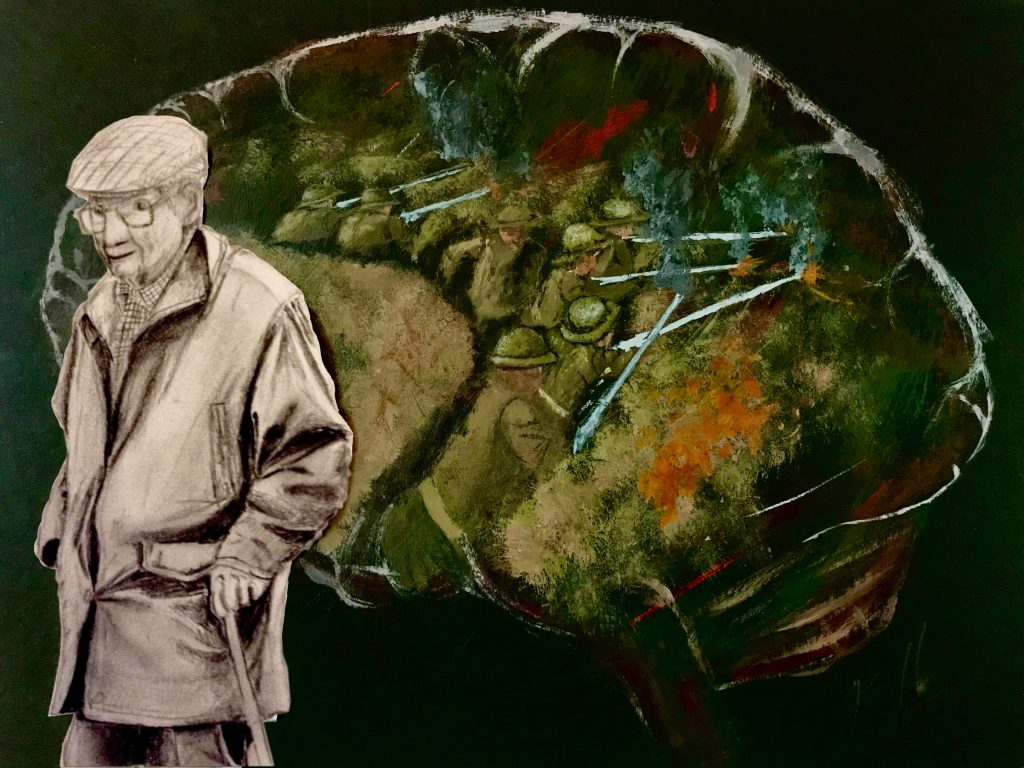
“A veteran mind,” graphite pencil and acrylic paint
Soldiers and veterans of any country face immense trauma that can stay with them throughout life. In many cases, the horrors of war become the defining moments in their lives and can rarely be forgotten even, and especially, late in life.

About the Creator:

Artist: Zain Mehdi is an M1 at the University of Iowa Carver College of Medicine. He previously studied molecular and cell biology and English at Cornell University. Originally from Pittsburgh, Zain has had a passion for drawing, painting, and writing since kindergarten.

Interviewer: Anna Graeff is an M2 at Carver College of Medicine with an undergraduate degree in Psychology from Iowa State University. She has two adorable pet Yorkies, which distract her from studying a lot of the time. She loves art and became interested in creating her own over the past year. Her favorite medium to create is embroidery.

Artist FeaturePainting

Artist Feature: Maggie Gannon

Maggie Gannon is a fourth-year student at the Carver College of Medicine who is working on a series of histology-inspired paintings for her Humanities Distinction Project in collaboration with Dr. Nathen Swailes. The Appendix‘s Ananya Munjal had an opportunity to interview her.

Q: When and how did you get into painting?
My mom is an artist so art has been a part of my life for as long as I can remember. In college I had a hard time deciding between pursuing a career in art or science, so as a medical student I wanted to do a project to tie those two parts of my life together. I would show my mom histology slides of what we were learning in class because I found them visually interesting and she thought it would be cool if I translated those images into abstract paintings. 

Q: What does your creative process look like?
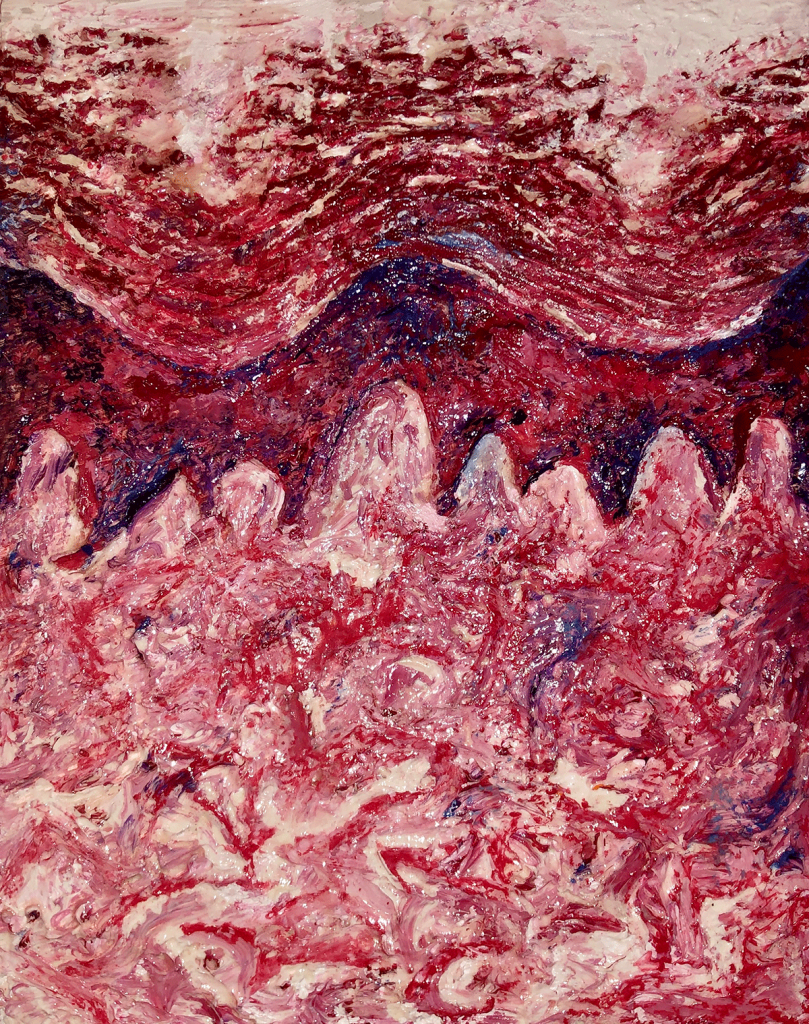
Dr. Swailes is my 50/50 partner in this— it’s his eye that sees the composition of the histology images and then sends them to me. The process starts with him finding a slide that is visually interesting and compositionally strong, which is very important. I kind of have the easy part which is moving paint on the canvas. I usually start with modeling paste which is a water-based medium that can be used to thicken the paint or be used as a base to create texture on the surface. I want people to feel like my paintings are like a cell on a slide, more than two-dimensional. I prefer oil paint over acrylic— it is more expressive and you can mix and modify it throughout the process since it stays wet for days.

“H&E Stain of Thick Skin; Dermis and Epidermis”

Q: How do you think your art reflects in your daily life?
My mom is a trained artist and my dad is an engineer. In my house there has always been a dichotomy of the creative and the black-and-white. As scientists and physicians we dedicate our whole lives to learning the hard truths that constitute the hard truths constituting the framework of medicine, but I was surprised to find once I got to the wards how much more messy and abstract medicine was than what we had spent our lives learning the first few years of medical school. I wanted to do a project where I could take a concrete image and “abstract it” to portray that idea. 

Q: What are you working on right now?
Currently I am working on another histology painting of basal cell carcinoma in collaboration with Dr. Swailes. The difficult part for me is finding a jumping off point for painting and composition, so he does the part by sending me compositionally cool images. 

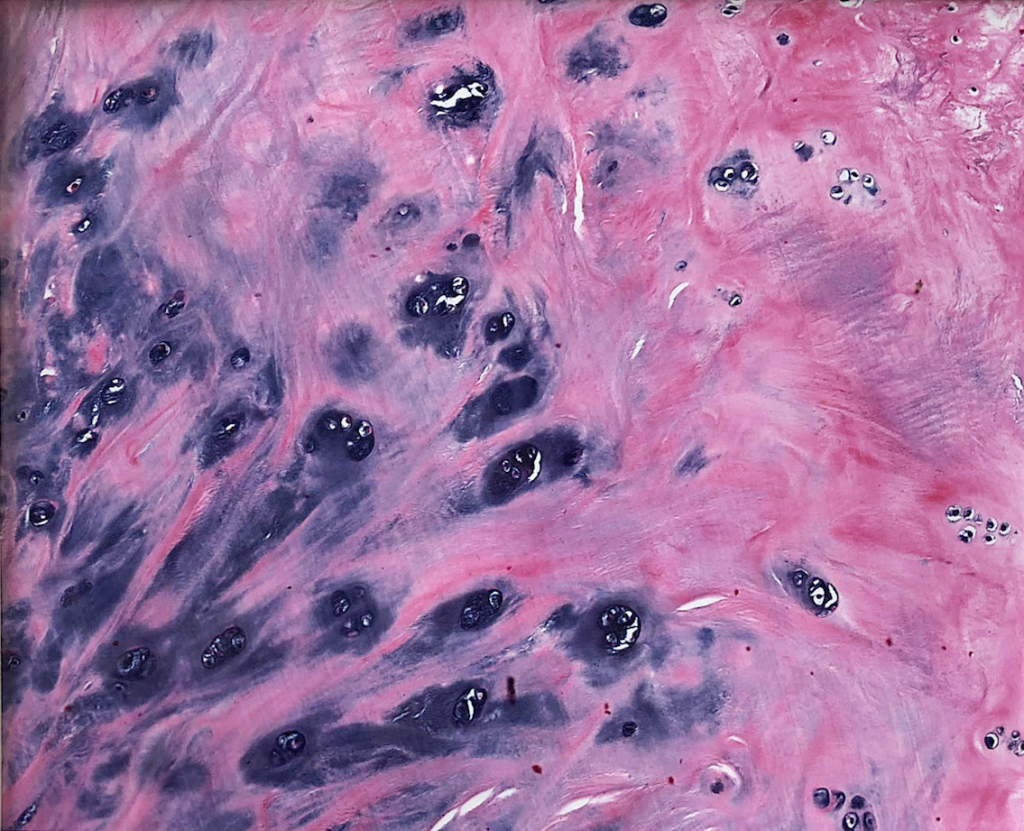
“Vertebral Metastatic Adenocarcinoma” Histology Slide, Swailes
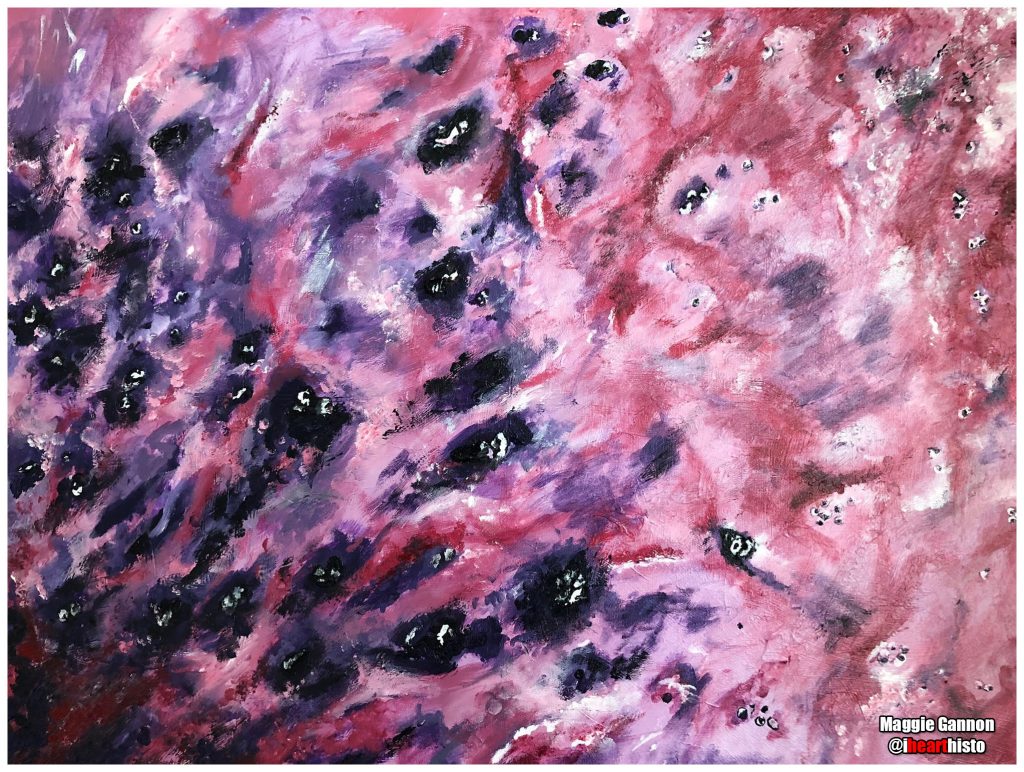
“Vertebral Metastatic Adenocarcinoma” Painting, Gannon

Q: Who or what is your inspiration to create? 
My mom is an obvious answer to this, she is an insanely creative person and there wasn’t a blank wall in my house growing up. She is an amazing artist and is always exploring new techniques and making art all the time. My “what” is more abstract for me, a lot of times I use my artwork to decompress. I have a little art studio in my apartment where I just have a canvas up all the time and if I’m not working on something concrete I like to just push paint around and follow my brush where it goes and create based on what I’m feeling. 

Q: What art do you like to consume?
I follow a lot of artists on Instagram and VSCO, I love really graphic 3D and 2D pieces. It amazes me how creative people are. Some of my artist recommendations to look out for on instagram: @gannonpeggy @chadknight @bodeburnout @bouboudesign_


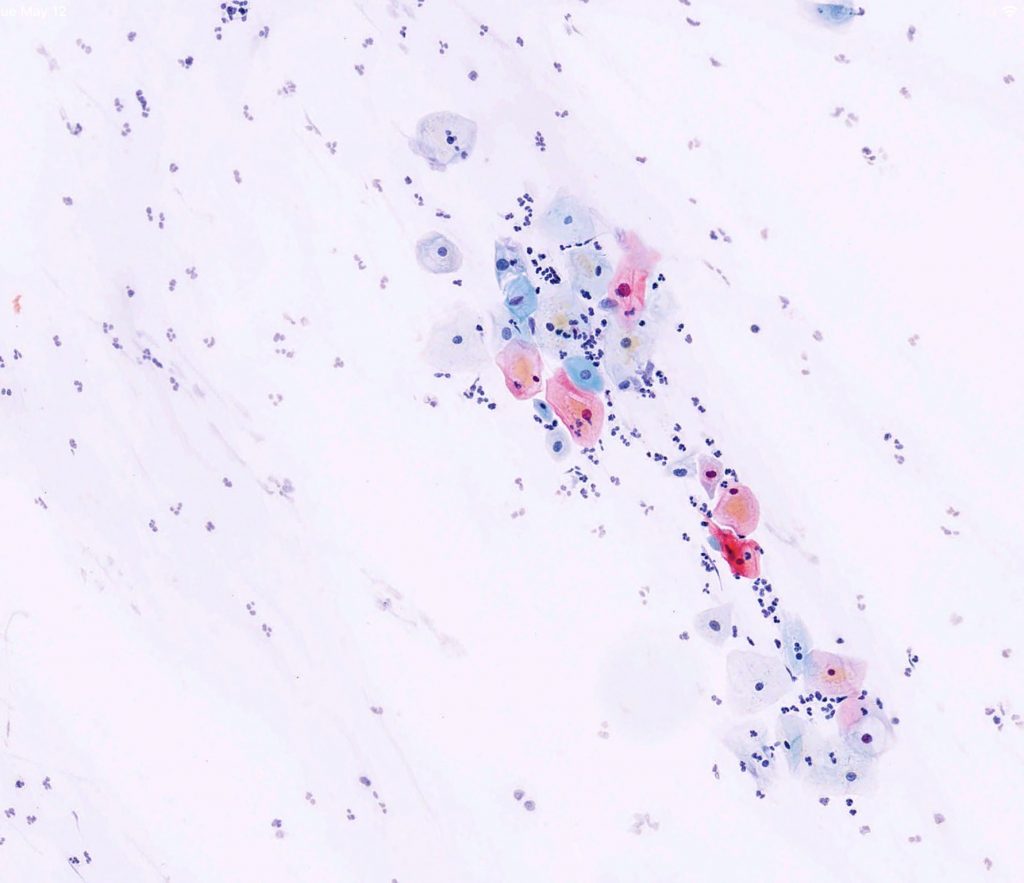
“Pap smear; mild cervical dysplasia” Histology Slide, Swailes
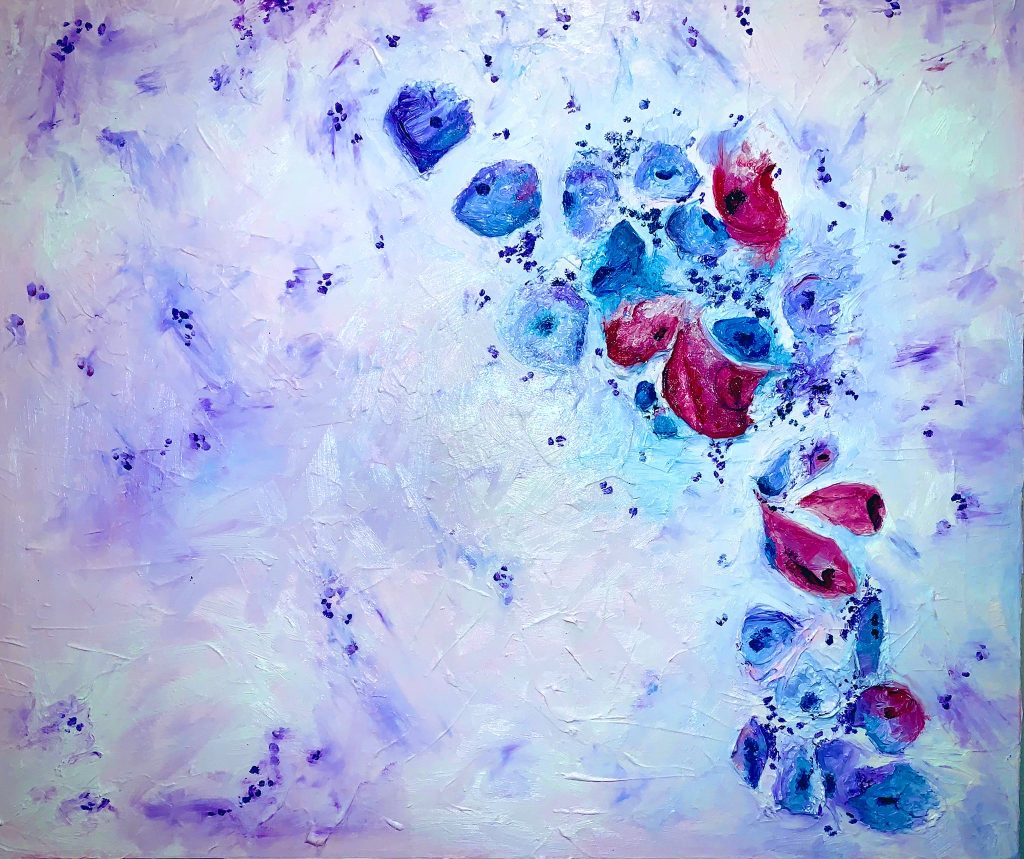
“Pap smear; mild cervical dysplasia” Painting, Gannon

Q: What would you like people to know about your art?
I try to capture the “mood” of the disease or pathology or cell that I am painting. For the painting of metastatic adenocarcinoma in bone that I did in collaboration with Dr. Swailes I darkened it a little bit compared to the picture to make it a bit angrier— I like to capture the feeling of what I am painting within the picture itself.

Q: How has creating your art changed you as a person?
Art has always been an outlet for me, we all have things we do outside of the hospital to ground us and this is mine. I feel that having an outlet like this makes me a better doctor and a better person to be around in the hospital. Painting is a very mindful thing to do and so this is something I can do where I have to focus on what I’m doing without being distracted and there are very few things like that for me. I think it slows me down and we all need that, and I feel very fortunate to do this outside of work because it keeps me sane.

About the Creator:

Artist: Maggie Gannon is an M4 and aspires to be a urologist. She spends her time outside of the hospital training for ultramarathons and walking her dog, Leo. Her favorite medium is oil paint because they blend beautifully (they smell the best too!).

Interviewer: Ananya Munjal is an M2 at the Carver College of Medicine. She studied human physiology and writing as an undergraduate and enjoys exploring the vast intersections between literature and the sciences. In her free time Ananya enjoys running, cooking, and hanging out with the Appendix team. Her favorite medium to create is writing prose poetry.